
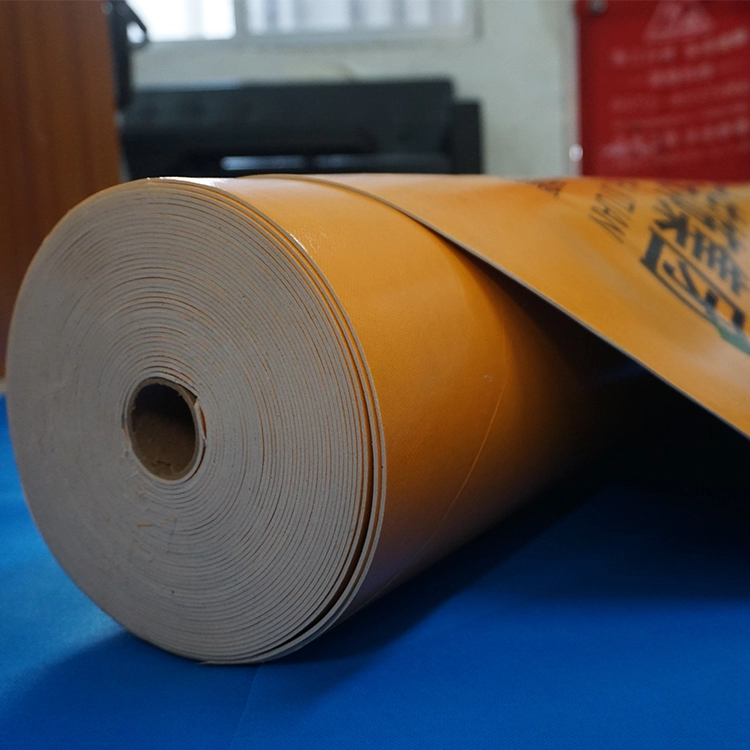
Quick answer
Choose self-adhesive decoration floor protective film when the film must stay fixed under foot traffic, when dust ingress at the edges is unacceptable, or when the floor is a finished surface you cannot risk. Choose standard loose-lay film when you need fast coverage of large areas, when the substrate is uneven, or when the film will be repositioned repeatedly during the project.
How each construction works
Self-adhesive film
A water-based acrylic adhesive is applied to the underside of the carrier film. The film is rolled out, the release liner peeled back, and the sheet bonded directly to the floor. The adhesive is designed to hold under lateral shear — the dragging force of boots, ladders and knee-boards — while releasing cleanly when the film is peeled at the end of the job.
Standard loose-lay film
No adhesive. The film is held in place by its own weight, by friction against the floor, and by tape at the seams and perimeter. It relies on the installer to build a continuous taped surface. Where it is laid correctly, a taped loose-lay sheet performs well on smooth substrates for short durations.
Side-by-side comparison
| Factor | Self-adhesive film | Standard loose-lay film |
|---|---|---|
| Edge sealing | Excellent — bonded, no dust creep | Depends entirely on taping quality |
| Installation speed | Slower per square metre | Very fast on large areas |
| Resistance to movement | High — resists shear and dragging | Low — can ripple and shift under load |
| Performance on uneven floors | Requires a sound, smooth substrate | More forgiving |
| Repositioning | Difficult once bonded | Easy |
| Residue risk | Managed by adhesive grade and dwell time | None |
| Best duration | Days to several months | Hours to a few weeks |
Choose self-adhesive when…
- The floor underneath is finished and expensive — polished concrete, hardwood, natural stone, epoxy resin.
- The work generates fine airborne dust — sanding, grinding, plastering — where any gap in the film allows dust to migrate beneath it.
- Trades will be walking, kneeling and dragging equipment across the surface for weeks.
- You need a printed safety or branding surface that must stay perfectly aligned and readable.
In these situations the adhesive is not a convenience feature — it is the mechanism that keeps the protective layer continuous. A loose-lay sheet that ripples under a ladder foot instantly creates an exposed strip of floor.
Choose standard loose-lay when…
- You are covering large areas quickly, such as an entire open-plan floor plate before a first-fix trade arrives.
- The substrate is uneven, dusty or still curing, so no adhesive would bond reliably anyway.
- The film is temporary and will be moved — a short dust barrier between two phases of work.
- You need the lowest material cost per square metre and the traffic class is genuinely light.
The hybrid approach used on most commercial sites
On mixed projects the most efficient specification is rarely one or the other. A typical commercial fit-out uses loose-lay film for corridors and general circulation, then switches to self-adhesive film in the rooms that matter: finished bathrooms, lobbies with stone floors, and any area receiving paint or adhesive spill risk.
- Lay loose-lay film on circulation routes and protect the seams with a compatible tape.
- Vacuum the substrate in finished rooms before bonding self-adhesive film.
- Overlap self-adhesive sheets by 30–50 mm and press the overlap firmly.
- Inspect both surfaces at every trade handover and patch lifts immediately.
Frequently asked questions
Q: Will self-adhesive floor film leave sticky residue?
A: Not if the adhesive grade matches the substrate and the dwell time. Water-based acrylic systems are formulated for clean peel from sealed concrete, tile, laminate and hardwood. Residue problems almost always come from using a long-dwell grade on a fresh or waxed floor, or from leaving film down for many months in direct sun.
Q: Can loose-lay film be used for painting?
A: It can cover the centre of a room, but the perimeter still needs to be sealed with tape. For spray painting, self-adhesive or paint-specific film is strongly preferable because overspray mist settles into any unsealed edge.
Q: Which type is cheaper overall?
A: Material cost per square metre is lower for loose-lay film. Installed cost is often lower for self-adhesive film, because it needs less taping, less re-laying and less patching across a multi-week programme.
Q: Does self-adhesive film work on freshly poured concrete?
A: Wait until the slab is dry and cured. Adhesive cannot develop full bond on a damp or dusty surface, and trapped moisture is the main cause of both lifting and staining.
Specify with confidence
Green Protect produces both self-adhesive and standard decoration floor protective film, plus the high-elasticity, flame-retardant and paint-specific variants needed to complete a specification. Tell us your substrate, traffic class and project duration and we will recommend the right construction — with OEM/ODM support, custom widths and printed branding for distributors.